EPC C by 2030 for Social Housing: What Providers Need to Plan For
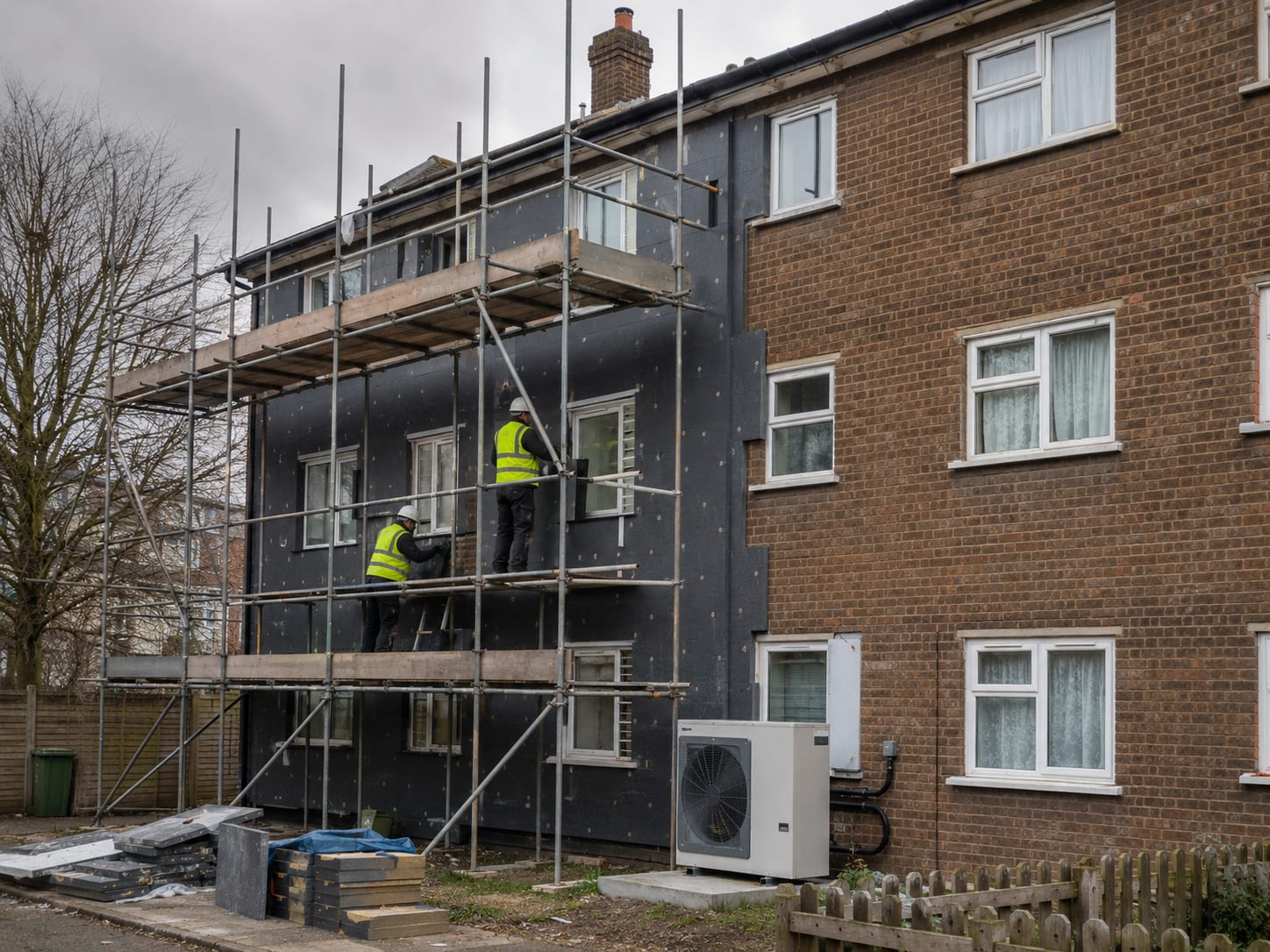
The confirmed minimum energy efficiency standard for social rented homes — what must be met by 1 April 2030 and 2039, the £10,000 cost cap, available funding, and how providers should plan retrofit works.
Social landlords in England must bring every rented home up to EPC band C, or the equivalent rating under the reformed EPC, by 1 April 2030 — measured on one of three metrics (fabric performance, heating system or smart readiness) — and then meet a second metric by 1 April 2039, unless a valid exemption applies. The government confirmed the standard in its consultation response of 28 January 2026 and finalised the detail in April 2026, including a £10,000 per-home spend cap for each stage. For housing providers and local authorities, that means a stock-wide, funded retrofit plan needs to be in motion well before the end of the decade.
This guide, from RS Construction and Property Services Ltd — a social housing contractor working with housing providers and local authorities across East London and London since 2010 — explains what the new minimum energy efficiency standard (MEES) requires, how the three metrics and the cost cap work, what funding exists, and how to sequence the works alongside voids, planned maintenance and Decent Homes programmes.
What is the minimum energy efficiency standard for social housing?
Until now, social rented homes in England have had no legal minimum energy efficiency rating. Private landlords have had to meet EPC band E since 2018 (for new tenancies) and 2020 (for all tenancies), but the social sector was covered only by the thermal comfort criterion of the Decent Homes Standard. The government consulted on a social rented sector MEES from July to September 2025, published its response on 28 January 2026 alongside the reformed Decent Homes Standard, and issued the final detail in April 2026.
The original proposal was for every home to reach band C on two metrics by 2030. After consultation the government softened this to a two-stage approach: one metric by 2030 and a second by 2039. The "fabric first" principle is no longer mandatory, so landlords can choose the metric that best suits each part of their stock.
What exactly must social landlords achieve, and by when?
- By 1 April 2030 — every social rented home must reach band C (or equivalent) on one of three metrics: fabric performance, heating system, or smart readiness. The landlord chooses which metric applies to each home.
- By 1 April 2039 — the same home must reach band C on a second of those three metrics.
- Compliance is judged against the reformed EPC metrics. A home that already holds a current EPC at Energy Efficiency Rating C or above before 2030 continues to count as compliant until that certificate expires.
- Where a home cannot reasonably reach the standard, a registered exemption applies — including a spend exemption of £10,000 per home for each stage. Social landlords are expected to report their reliance on exemptions to the Regulator of Social Housing.
What are the three EPC metrics?
The familiar single A–G EPC score is being replaced by a set of separate metrics as part of the wider EPC reform. Three of them are used for the social housing standard:
- Fabric performance — how well the building retains heat: insulation to walls, roofs and floors, window and door performance, and airtightness.
- Heating system — the efficiency and carbon intensity of the heating and hot water system, which favours efficient, low-carbon systems such as heat pumps over older gas boilers.
- Smart readiness — whether the home can use smart controls, time-of-use tariffs, and technologies such as solar PV or battery storage to manage its energy.
The assessment method is changing too. Since 15 June 2025, new domestic EPCs for existing homes have been produced under RdSAP 10, which relies on evidence — boiler model numbers, insulation certificates, glazing specifications — rather than default assumptions, and the reformed EPC itself, calculated with the new Home Energy Model, is expected to launch in the second half of 2027. The paperwork behind every retrofit measure now has a direct bearing on the rating a home receives.
How many social homes are still below EPC C?
- Social housing is already the most energy-efficient tenure in England: the English Housing Survey put 67% of local authority and 68% of housing association homes in bands A to C in 2023.
- That still leaves a large tail. The National Housing Federation estimates around 713,000 housing association homes — about 27.5% of the stock — remained in bands D to G after a decade in which associations upgraded 578,000 homes to band C or better.
- The English Housing Survey 2024–25 puts the average cost of reaching band C at £7,480 across all tenures, with social rented homes the cheapest to improve — so the £10,000 cap will cover most, but not all, homes.
How does the £10,000 cost cap work?
The cost cap is the main safety valve in the standard. If a landlord has spent £10,000 on relevant improvements to a home and it still does not reach band C on the chosen metric, the home can be registered as exempt for that stage. A second £10,000 cap applies to the 2039 stage, and the government has signalled it may extend the caps in later years. Up to two EPC assessments can be counted within each £10,000; a new gas boiler cannot. The final response also sets out from when spending counts, so check the published rules before assuming historic works qualify.
What funding is available for social housing retrofit?
- The Warm Homes Plan commits £13.2 billion over 2025/26 to 2029/30 to upgrading homes across England.
- Warm Homes: Social Housing Fund Wave 3 allocated £1.29 billion to 144 projects for delivery between April 2025 and March 2028, targeting social homes below band C. Applications closed in November 2024 and all grant must be spent by 31 March 2028; guidance issued in May 2026 added a further £295 million available for 2026/27.
- All publicly funded domestic retrofit is delivered under PAS 2035, which requires a whole-house assessment, a Retrofit Coordinator overseeing the project, and installers certified to PAS 2030.
How should housing providers plan a retrofit programme?
- Start with the data: get current, evidence-based EPCs across the stock and choose the 2030 metric per archetype, not per policy — a well-insulated 1990s estate may already sit close to fabric C, while a solid-wall Victorian terrace may reach band C more cheaply via the heating or smart readiness route.
- Sequence retrofit with the programmes already on site — void refurbishments, kitchen and bathroom replacements, heating renewals and window programmes are the moments when insulation, ventilation and controls can be added at the lowest marginal cost.
- Treat Decent Homes, Awaab’s Law and MEES as one plan: better fabric and ventilation cut condensation and mould risk, and heating renewals count towards both thermal comfort and the heating system metric.
- Keep installer certificates, product specifications and commissioning records for every measure — under RdSAP 10, evidence directly affects the rating.
- Budget for the tail: identify early the homes likely to need a spend exemption and plan the £10,000 of works that gets them closest to the standard, rather than discovering them in 2029.
Key takeaways
- Social rented homes in England must reach EPC band C on one of three metrics — fabric performance, heating system or smart readiness — by 1 April 2030, and on a second metric by 1 April 2039.
- Fabric first is not mandatory, so the metric can be chosen per home; a £10,000 per-home spend cap applies to each stage, with exemptions reported to the Regulator of Social Housing.
- Roughly a third of social homes were still below band C in 2023, and the English Housing Survey puts the average cost of reaching C at £7,480.
- Warm Homes: Social Housing Fund Wave 3 (£1.29 billion, spend by 31 March 2028) and PAS 2035 delivery frame most funded programmes.
- The cheapest route to compliance is to fold energy measures into voids, planned maintenance and Decent Homes works already programmed.
Does every social home have to be EPC C by 2030?
Every social rented home in England must either reach band C on one of the three metrics by 1 April 2030 or hold a valid registered exemption — for example, where £10,000 has been spent on relevant improvements and the home still falls short. Homes that already have a current EPC at rating C or above remain compliant until that certificate expires.
Which EPC metric should a social landlord choose first?
There is no single right answer, which is why the government dropped the mandatory fabric-first rule. The practical approach is to model each stock archetype against all three metrics and pick the one that reaches band C at the lowest cost and disruption. Fabric improvements deliver the biggest comfort and damp-prevention benefits for tenants, so many providers will still lead with fabric where the cost is manageable.
Can energy efficiency works be done during a void?
Yes, and it is usually the most efficient moment. Insulation, ventilation upgrades, heating controls and window or door replacement are all easier, faster and cheaper in an empty property, and the incoming tenant is spared disruptive work later. The trade-off is a longer void period, weighed against the cost of returning to an occupied home mid-tenancy.
How RS Construction supports energy efficiency and retrofit programmes
RS Construction and Property Services Ltd delivers the building works that social housing retrofit programmes depend on — void refurbishments, planned component replacement (kitchens, bathrooms, windows and doors), heating and electrical upgrades, ventilation and damp remediation — for housing providers and local authorities across East London and London. Our directly employed, multi-trade workforce sequences the works under one accountable team, with Gas Safe and NICEIC registered engineers certifying the compliance elements and documentation handed back for your EPC evidence file. If your 2030 plan needs delivery capacity in London, we are happy to talk through your stock and programme.
Related
Planning a project across East London or London?
Get a free estimate